
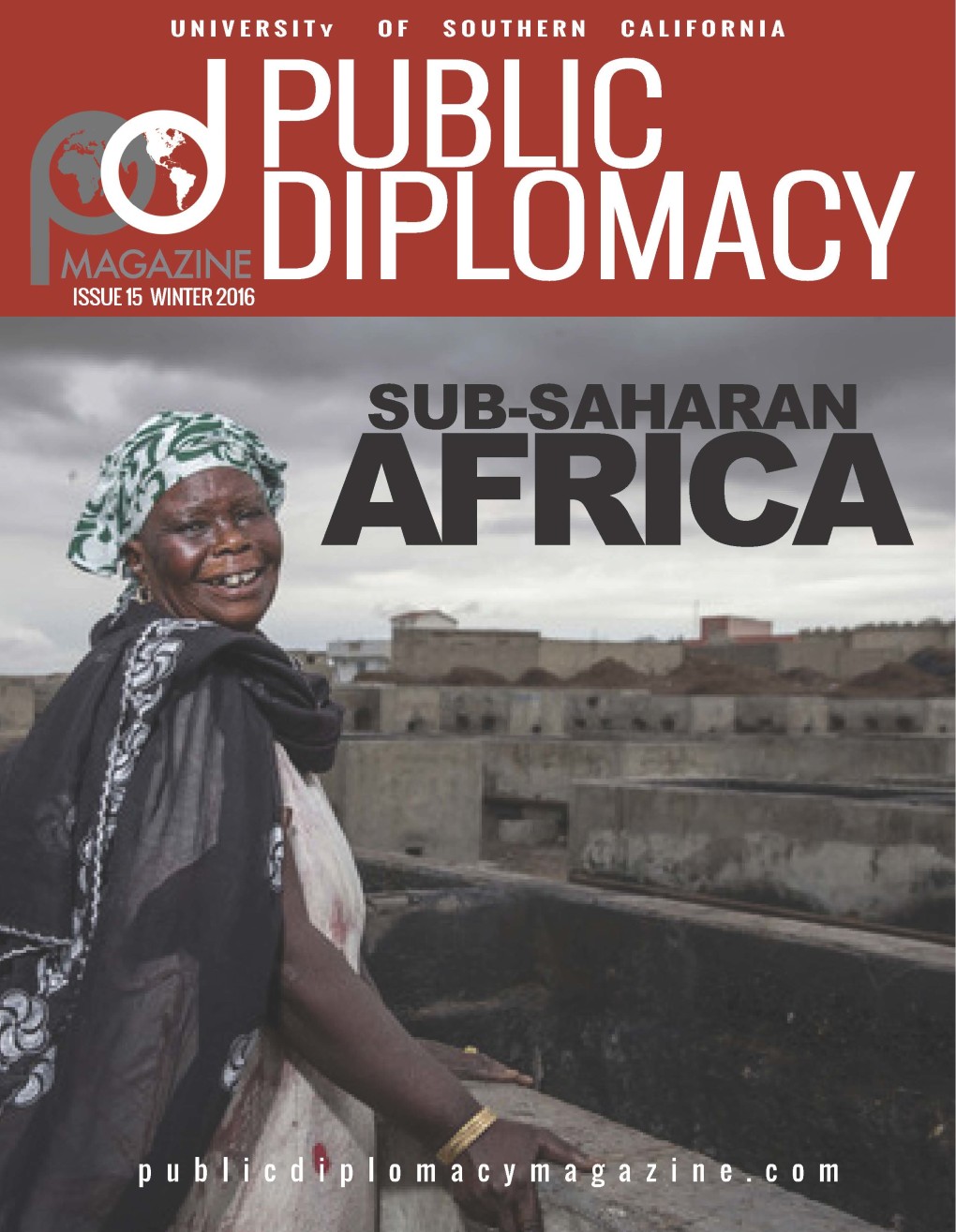
The President/Founder Eko International Film Festival Mr Hope Obioma Opara’s paper on “Film & Cultural Diplomacy: Nollywood Case” which have been published in University of Southern California USA, Public Diplomacy Bi-Annual Magazine. On Pages 33-37.
The continent of Africa is made up of a great number of ethnic cultures, each of which encompasses different tribes and languages. This diverse cultural makeup is exhibited in films of multiple genres that tackle the myriad issues facing the continent. Films are a medium through which cultural diplomacy and international relations can be conducted because they reflect and convey cultural and societal values and promote understanding of the other when presented before large audiences at film festivals and the like. A good example of the transformative value of film can be seen in the case of Nollywood and its impact on Nigerian foreign policy. FILM AS CULTURAL DIPLOMACY
Each year, filmmakers around Africa produce thousands of films, confirming the key position film holds as a product of strategic and artistic relevance. It is an artistic medium that imbibes and conveys the values and beliefs of the culture within which and for which it is made. Because of the significant cultural diversity in Africa, filmmakers there have a multitude of approaches to film production and storytelling. Films can be used as a tool of cultural diplomacy, which is defined as the exchange of ideas, information, art, and other aspects of culture among nations and their people in order to foster mutual understanding. Popular culture and art play important roles in how a country is perceived by the world, but film is unique because it is easily accessible and often watched by people who might otherwise have no contact with art. Unlike other art forms, film produces a sense of immediacy because the pictures tell stories that viewers can see unfolding. Film’s unique ability to create the illusion of life and reality can offer the world new perspectives, especially those from cultures and places that have traditionally been marginalized. It is an extremely
powerful medium. For example, film can depict human rights abuses and repression in a way that challenges audience members to empathize and consider how justice could be served and wounds healed. Cinema brings people together and creates a forum for individuals on both sides of the lens. Film can empower the audience with the knowledge that personal commitment can make a difference. Often, films bring up issues that cannot be reached through other, more traditional mediums of discourse. They often revolve around new issues and help to start a discussion in societes around them, a discussion that can lead to change. Films can foster the growth of civil society, mutual cooperation, and understanding by serving as a flexible, universally accepted vehicle for rapprochement, even between countries where diplomatic relations have been strained or are absent. FILM FESTIVALS AND PUBLIC DIPLOMACY
Film festivals are a platform for cross-cultural dialogue, bringing together professionals from different countries to exchange ideas and experiences. They juxtapose works by revolutionaries, cultural figures, environmentalists, and political advocates of all types. Exhibiting the continent’s cultural diversity is often a motivation that unites directors from every corner of Africa, pushing them to produce their work. FILMS OFTEN EXPLORE DIFFICULT SOCIAL AND POLITICAL ISSUES THROUGH VARYING VIEWPOINTS. THIS CONTRIBUTES TO THE DEVELOPMENT OF CROSS-CULTURAL DIALOGUE AND MUTUAL UNDERSTANDING BETWEEN COMMUNITIES,
WHICH REINFORCES THEIR PEACEFUL CO-EXISTENCE.
To fully evaluate the role of film festivals, one must look at the contribution they make to a country’s soft power, and its efficacy as a method for cultural engagement and exchange. These festivals usually feature films that were produced in the previous year, and welcome entries from different genres, including documentary, short film, religious, political, and cultural. In screening such a diverse range of films, festivals can act as an instrument for positive change by encouraging conversation around social, political, and cultural problems. FILM AND CULTURE
A community’s culture consists of conventional patterns of thought and behavior, including values, beliefs, rules of conduct, political organization, economic activities, and the like, which are passed on from one generation to the next by learning – not by biological inheritance. Culture is learned and dependent on being brought up within a framework – a cultural space. Many film festivals present works that reflect the traditions, customs, and rituals of the inhabitants of different countries and in doing so, influence the host audience’s cultural development and understanding of the other. In this sense, cinema presents inexhaustible possibilities for getting acquainted and sympathizing with people of other nationalities and religions. Looking at the screen and into another, sometimes foreign world, audiences can recognize what all humans share – joys, sorrows, hopes, and adversities. Films often explore difficult social and political issues through varying viewpoints. This contributes to the development of crosscultural dialogue and mutual understanding between communities, which reinforces their peaceful co-existence.
To know someone else means to see oneself in him or her. Film allows people to understand the values and culture of a community. People often take for granted the cultural spaces in which they move around, because in such familiar terrain, they understand what is going on and why. It can be hard to imagine that someone from a different culture, stepping into one’s own, might find it strange and confusing. It can also be hard to recognize that someone’s lack of experience and understanding about one’s cultural space limits their ability to make their own choices and express themselves. This is because in a foreign cultural space, one tends to feel a loss of control that only returns when one has become familiar with the new surroundings. This is why film festivals play a pivotal role for real cultural exchange. IN A FOREIGN CULTURAL SPACE ONE TENDS TO FEEL A LOSS OF CONTROL THAT ONLY RETURNS WHEN ONE HAS BECOME FAMILIAR WITH THE NEW SURROUNDINGS. THIS IS WHY FILM FESTIVALS PLAY A PIVOTAL ROLE FOR REAL CULTURAL EXCHANGE.
The culture of a nation may only develop in a dialogue with other cultures. Such films, while observing closely the life of strangers, may be imbued with common human problems, troubles, joys, and adversities. They will play a role in exploring the most difficult socio-political problems, encouraging tolerance, and emphasizing the shared human experience. These films can also be a tool of advocacy, reconciling with the past to shape a better present and future. In Africa, some harmful traditions that have been practiced for hundreds of years are no longer in step with modern civilization’s values and beliefs. Some of the
films submitted to film festivals in Africa explore these issues and work through soft power to bring change. For instance, B for Boy, a film produced by the Nigerian director Chika Anadu and set in his home country, is a contemporary drama about one woman’s desperate need for a male child. It explores the discrimination of women in the name of culture and religion. This mindset is predominant in eastern Nigeria where women are not allowed to inherit properties from their father; however, legislators are now in the process of passing a law that would allow women to inherit. Another film, I CRY, deals with the issue of female genital mutilation, a harmful cultural tradition that is still being practiced in secret in Nigeria. The Clan’s Wife is a film produced by a Ugandan filmmaker Hassan Mageye. This piece contributed a major push for the fight against wives being inherited. This is a common practice in Uganda where widows are forcibly inherited, along with other property, by male in-laws upon the death of a husband. The Clan’s Wife tells a compelling story of how the practice of wife inheritance claimed many lives in the area of Ankole in a time when AIDS was less well understood. The storyline revolves around one tragic family who contracts the deadly disease through the forced sharing of a wife. Films of this sort attempt to discourage some of these harmful traditions and encourage change by bringing these issues into the public spotlight. FILM AND NATION-BRANDING: A NOLLYWOOD CASE STUDY
Film can also be a tool for re-branding a country, as the Nollywood film industry has been for Nigeria. The Nigerian government has made citizen diplomacy a central part of its foreign policy strategy – the first time it has enunciated a clear-cut foreign policy objective. Nigeria’s image abroad has been battered by corruption, abject poverty, and
crimes such as bunkering, kidnapping, fraud, and electoral manipulation. Previously, movies had portrayed Nigeria in a bad light. To counter this, the government evaluated the movies produced in Nigeria and encouraged filmmakers to showcase the country’s value systems, rather than supernatural rituals. With a clear message and actions in terms of what it does and does not support in Nigerian film content, the government hopes that its cultural diplomacy work will enhance the country’s image in the international arena, expedite the government’s initiatives for national progress, and add value to Nigerian society. FILM CAN ALSO BE A TOOL FOR RE-BRANDING A COUNTRY, AS THE NOLLYWOOD FILM INDUSTRY HAS BEEN FOR NIGERIA.
Nigeria’s successful motion picture industry enhances the country’s image abroad through both formal and informal means. Nollywood contributes to Nigeria’s GDP and is one of the largest employers in the country, as well as being the second highest-producing film industry in the world. People from all over Africa and the world watch Nollywood films. Often, Nollywood stars are invited to attend special events outside Nigeria as representatives of the country and the industry. This has given the industry a staggering amount of soft power. THIS UNILATERAL BROADCASTING IS TRANSFORMED INTO AN AVENUE OF MULTILATERAL LEARNING THROUGH THE USE OF FILM FESTIVALS, WHICH SERVE TO INFORM AND INFLUENCE AN AUDIENCE WITHIN AND WITHOUT AFRICA, AND BECOMING A MAJOR ELEMENT OF CULTURAL DIPLOMACY WORLDWIDE.
Some Nollywood stars have enhanced Nigeria’s image through their philanthropic efforts. For example, Stephanie Okereke Linus works in collaboration with corporations to provide treatment for women with vesicovaginal fistula, a medical condition that has ravaged many women in Nigeria. Many other Nollywood stars advocate fighting violence against women, an end to child marriage, against rape, and campaigning for each girl’s right to an education. The Nollywood film industry has also attracted major Hollywood talent, for example, the American comedian and actor Danny Glover, also known as Childish Gambino, took part in an upcoming film about the Ebola virus.
THE NIGERIAN FILM INDUSTRY HAVE ENHANCED THE WORLD’S UNDERSTANDING AND RESPECT FOR NIGERIA, BUT THIS UNILATERAL BROADCASTING IS TRANSFORMED INTO AN AVENUE OF MULTILATERAL LEARNING THROUGH THE USE OF FILM FESTIVALS
Nollywood has also produced some international ambassadors who represent the Nigerian people for nongovernmental agencies such as UNICEF and Amnesty International, and major corporations such as Land Rover motor manufacturing company and Unilever consumer goods company. The industry also contributes content to multi-national cable networks like MultiChoice Africa, the biggest cable TV network in South Africa, and StarTimes, cable TV based in China. Movies hailing from Nollywood can be found on popular online platforms such as Iroko TV, Afrinolly, and Netflix, as well as search engines such
as Google and Yahoo, etc. Nigerian films and the Nigerian film industry have enhanced the world’s understanding and respect for Nigeria, but this unilateral broadcasting is transformed into an avenue of multilateral learning through the use of film festivals, which serve to inform and influence an audience within and without Africa, and becoming a major element of cultural diplomacy worldwide.

Mr Hope Obioma Opara (President/Founder Eko International Film Festival)
Hope Obioma Opara is the President/ Founder of the Eko International Film Festival (www.ekoiff.org), and the Managing Director of Supple Communications Limited and Flonnal Limited. He holds a Masters of Business Administration and he is a member of the Nigerian Institute of Management (NIM). He is also an Associate Registered Practitioner in Advertising (ARPA) in the Advertising Practitioners Council of Nigeria. Having attended film festivals across Europe, Hope was inspired to establish a film festival in Nigeria in order to foster the growth and development of the “Nollywood” film industry. In addition, he founded Supple Magazine (www.supplemagazine.org), a publication devoted to covering the global film industry and international film festivals.